
Dental implants have been changing patients’ lives for more than 50 years. With a 95% success rate, they offer longer-lasting results that traditional dental bridges and dentures cannot match. But what makes them successful? Could it be the technological innovations dentists use that make them stand out from others? Keep reading to find out.
What Kind of Technologies Are Used for Dental Implant Placement?
Dentists today use advanced technological techniques to increase the success rate of dental implant placement. Some of the most frequently used devices include:
Digital Impressions
Dental implants are designed to support your custom restoration. This means that, depending on how many teeth you are missing, you will receive an implant crown, a denture, or a dental bridge. To make your new teeth, an accurate model must be captured so lab technicians can begin fabrication. Instead of relying on traditional dental putty, your dentist will use digital impressions. With a handheld, camera-tipped device, they will scan your mouth to create a 3D image that can be altered and adjusted before it is sent to the dental lab. This not only ensures greater patient comfort but also improved accuracy and precision when creating your custom restoration.
CT/Cone Beam Scanners
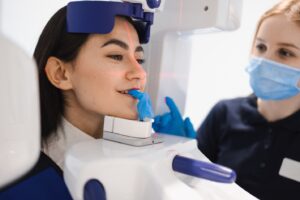
For dental implants to be successful, the planning process is one of the most pivotal components. This is why your dentist will use a 3D Cone Beam Imaging system or cone beam scanner. Rotating around your head a full 360 degrees, the device takes hundreds of photos that combine to create a single 3D image of your oral and facial structures.
Once visible on a nearby monitor, your dentist can evaluate the status of your existing smile, including your teeth, gums, jawbone, blood vessels, nerve pathways, and more. Using this image, they can plan your upcoming surgery, determining how many implants are required and how deep they need to go to ensure optimal positioning and stability.
Guided Dental Implant Surgery
Enhanced imaging isn’t the only reason for their high success rate. Guided dental implant surgery is also used to ensure better precision when placing each titanium post. Your dentist will create a surgical guide from a scan of your mouth. On the day of your procedure, they will place it on the arch, showing exactly where the implants need to go, their angle placement, and their depth.
Not only does this device lower the risk of complications during surgery, but it can also reduce the size of the incisions that are required to place each implant post. As a result, you may not need as much time to heal.
Dental implant technology is changing how dentists perform this procedure for patients in need. With a 95% success rate, it’s easy to see why so many people choose these prosthetics to restore their smile.
About the Author
Dr. Mark Makram is a highly skilled implant dentist who brings decades of experience and a passion for helping patients enjoy life with complete, fully restored smiles. Using the latest technological advancements to place dental implants, he delivers optimal results through enhanced imaging and surgical guides to replace missing teeth. Ready to let an expert rebuild your smile? Visit our website or call (239) 513-9990 to schedule a consultation.